I have acted as an expert witness since 2003, in criminal cases, personal injury and clinical negligence, and have given oral evidence more than 350 times.
I have prepared over 1,000 reports. As well as courts, I have carried out work for and provided opinion to the Parliamentary and Health Service Ombudsman, the Criminal Cases Review Commission, the Parole Board, the Upper Tribunal (Tax and Chancery Chamber), the First-tier Tribunal (Mental Health), HM Coroners, professional disciplinary hearings (for healthcare professionals, solicitors and police officers) and an ecclesiastical court. I have also delivered in-house training to the Mental Health Casework Section of HM Prison and Probation Service.
Notable cases
I have given oral evidence at the Old Bailey and the Royal Courts of Justice, and have provided expert opinion to the Court of Appeal in R v Abdul Hakeem Yusuf [2025] EWCA Crim 1010 and R v Damien Osmond [2025] EWCA Crim 835.
Instructed by the CPS, I gave written and oral evidence over three days at the Old Bailey in a complex corporate manslaughter prosecution of an NHS Trust – one of the first such prosecutions of an NHS Trust to proceed in England and Wales (R v Aninakwa and North East London NHS Foundation Trust, Central Criminal Court, sentencing remarks, November 2025).
In 2025 I provided expert evidence in the first prosecution under section 184 of the Online Safety Act 2023 of someone charged with encouraging serious self-harm online.
Dr Taylor’s report, giving as it does his endorsement to a diagnosis of ADHD and a new diagnosis of PTSD, does give some ground for matters which go to reduce culpability for this offending.
Court of Appeal judgment in R v Abdul Hakeem Yusuf [2025] EWCA Crim 1010
Criminal work
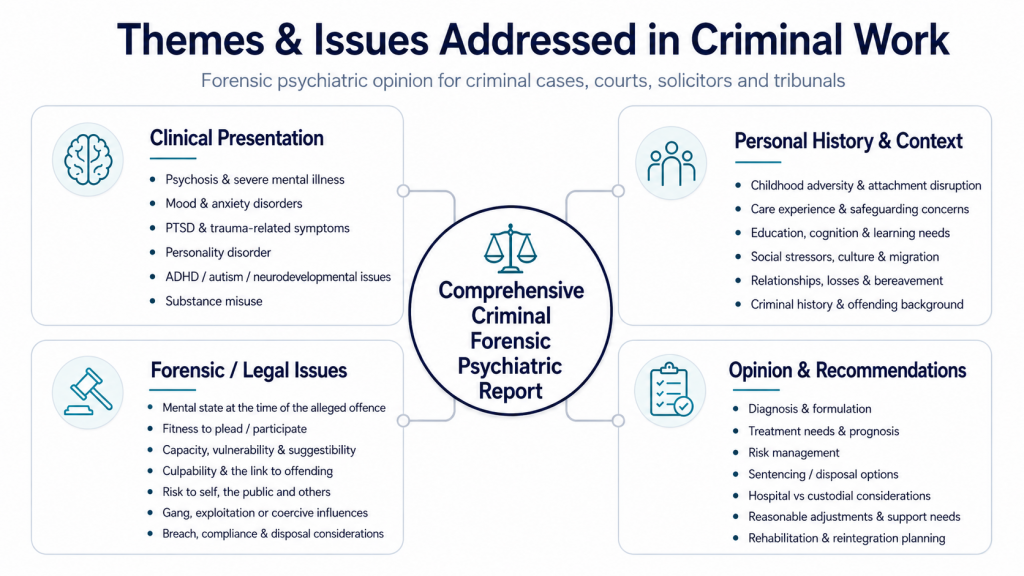
Typical issues include:
- Fitness to plead and stand trial, including contested fitness to plead hearings (in murder cases among others) and applications to vacate pleas already entered – see pritchardcriteria.uk for a practitioner guide to the Pritchard criteria
- Mutism
- Diminished responsibility
- Insanity
- Automatism
- Capacity to form intent
- Culpability
- Special measures
- Mitigation and sentencing
- Assessment of “dangerousness” (historically, under Indeterminate Sentences for Public Protection)
Many of these issues are ultimately matters for the court, but psychiatric opinion often assists courts in reaching their decisions.
I have often assessed people charged with:
- Homicide, especially where insanity, self-defence or diminished responsibility is raised
- Interpersonal violence, from attempted murder through GBH and ABH to common assault
- Sexual offences, including rape, sexual assault and offences against children
- Arson, both reckless and with intent
- Terrorist offences
- Robbery and burglary (domestic and commercial)
- Fraud and other financial crime
- Online offending, including online fraud, unlawful access to networks and systems, ransomware and cryptocurrency
- Blackmail, often sexual in nature
- Harassment and stalking, including of high-profile individuals and families
- Driving offences
Civil work
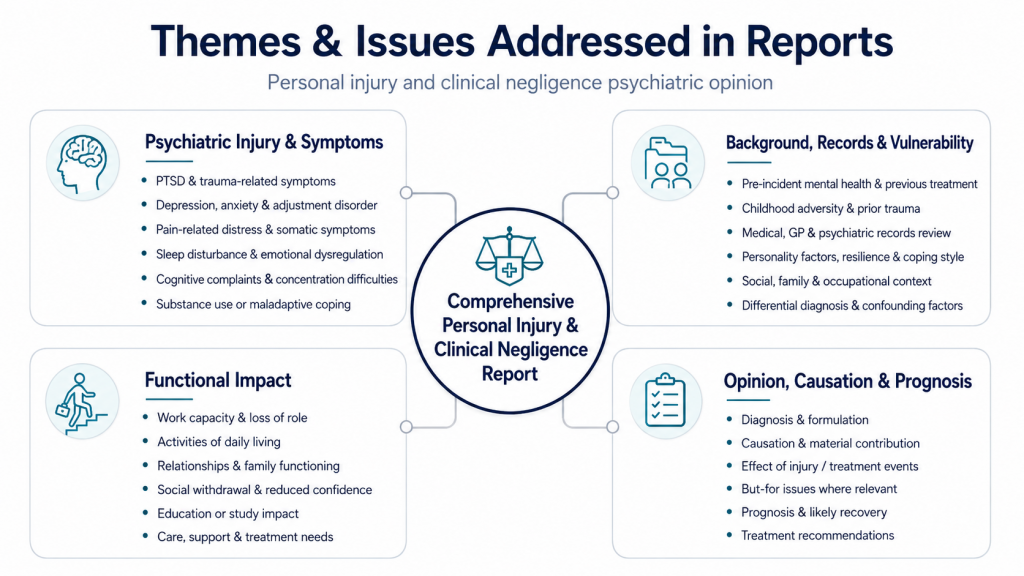
In personal injury and clinical negligence cases, psychiatric injuries have ranged from depressive disorders and PTSD to adjustment disorder, anxiety disorders, complex PTSD and somatic symptom disorder. These often follow physical injury, workplace difficulties or childhood abuse.
Autism spectrum disorder is frequently involved, particularly in cases involving financial and online institutions and cryptocurrency. Autism was a prominent issue in a relatively high-profile case in the Upper Tribunal, [2026] UKUT 00047 (TCC).
Dr Taylor … has considerable experience of treating people with autism, often exhibiting more serious mental health issues.
Upper Tribunal (Tax and Chancery Chamber), [2026] UKUT 00047 (TCC)
Conditions I assess
- Schizophrenia and other psychotic disorders
- Bipolar affective disorder
- Depressive disorders
- PTSD and complex trauma
- Autism spectrum disorder
- ADHD
- Personality disorders, especially dissocial and emotionally unstable (borderline) personality disorder
- Substance and alcohol use, including novel psychoactive substances such as “Spice”
Instructing me
How do I instruct Dr Taylor?
Instructions for Dr Nicholas Taylor are handled by Forensic Psychiatry Experts: email contact@forensicpsychiatryexperts.co.uk or call 0116 380 5641. He accepts instructions from the defence, the prosecution and the court in criminal cases, and from solicitors and medico-legal agencies in civil cases, and is happy to review a draft letter of instruction.
Where do assessments take place?
Many assessments can be carried out remotely by video. In-person assessments take place in prison for people on remand, or at Lion Court (LE65 1RT) or a solicitor’s office for people able to travel. Occasionally, usually for very frail or elderly people, an assessment at home is needed. Dr Taylor does not assess at police stations.
Can a second psychiatric report be arranged?
Yes. Where a second report from a psychiatrist approved under section 12 is needed (for example where the law requires evidence from two doctors), it can be arranged from another consultant within Forensic Psychiatry Experts. Each expert assesses independently and forms and reports their own opinion.
What is fitness to plead?
Fitness to plead is whether a defendant can participate effectively in their trial – for example understanding the charges, deciding how to plead, instructing their lawyers and following the evidence. In England and Wales it is assessed using the Pritchard criteria as developed by later case law. A full practitioner guide is at pritchardcriteria.uk.